







Your Practice Is Running.
Are You Running It?

The CEO framework for physician practice owners — operations, financials, people, and the systems that let you lead instead of just survive.
THE CEO ROLE IS VITAL. YOU BECAME THE CEO THE DAY YOU SIGNED THE LEASE.

The CEO is the heart of the practice. Not the hands.

Your job is not to do the work. Your job is to make sure the right work gets done — by the right people, in the right way, toward the right goal.

That distinction sounds simple. It isn't. Most physician-owners spend their entire career collapsing every role into one. They're the clinician and the scheduler fixer and the staff conflict resolver and the billing problem solver and the person who stays late when someone calls out. They're doing everything — which means they're leading nothing.

Here's what makes this unique to medicine: you are also the doctor. You should be in the exam room. You should be in the OR. That's not a distraction from your CEO role — that's the whole reason the practice exists. Your clinical excellence is the product. Protecting it is part of the strategy.

The tension isn't clinical vs. CEO. It's reactive execution vs. intentional leadership. The CEO sets the culture. You decide what this practice stands for, how people treat each other, what's acceptable and what isn't. Culture doesn't come from a values poster on the wall. It comes from what you tolerate, what you reward, and what you model every single day.

The CEO sets the strategy. Where is this practice going? Which services, which patients, which markets? These are not questions your office manager can answer. They're yours.

The CEO makes the plans. Not the to-do list — the plan. The quarterly priorities. The decision framework. The criteria for expansion, for hiring, for dropping a payer. You set the direction. Your team executes it.The balance looks like this: you show up clinically excellent and fully present for your patients — and you carve out protected time to lead the organization that supports that care. Neither role cannibalizes the other. Both are non-negotiable.

The goal isn't to stop being a great doctor. The goal is to stop being the only person holding everything else together.
The Core Philosophy (the "never negotiate these" rules)

Three Rules That Run Every Healthy Practice

Blurry to clear vision comparison — cataract surgery results at Stratus Eye in Suwanee, GA
Be Ethical.
Full Stop.
Every decision in your practice runs through this filter first. No revenue target, no staffing pressure, no growth goal overrides it. If it doesn't pass the ethics test, it doesn't happen. This is non-negotiable — and it's also what makes everything else trustworthy.
Femtosecond laser cataract surgery equipment used for patients of Stratus Eye at Northside Hospital Haw Creek
Take excellent care of patients.
Always.
This is why the practice exists. Not the revenue. Not the real estate. The patient in your exam chair who is trusting you with their health. Clinical excellence is the product. Protecting it is part of your strategy as CEO — not separate from it.
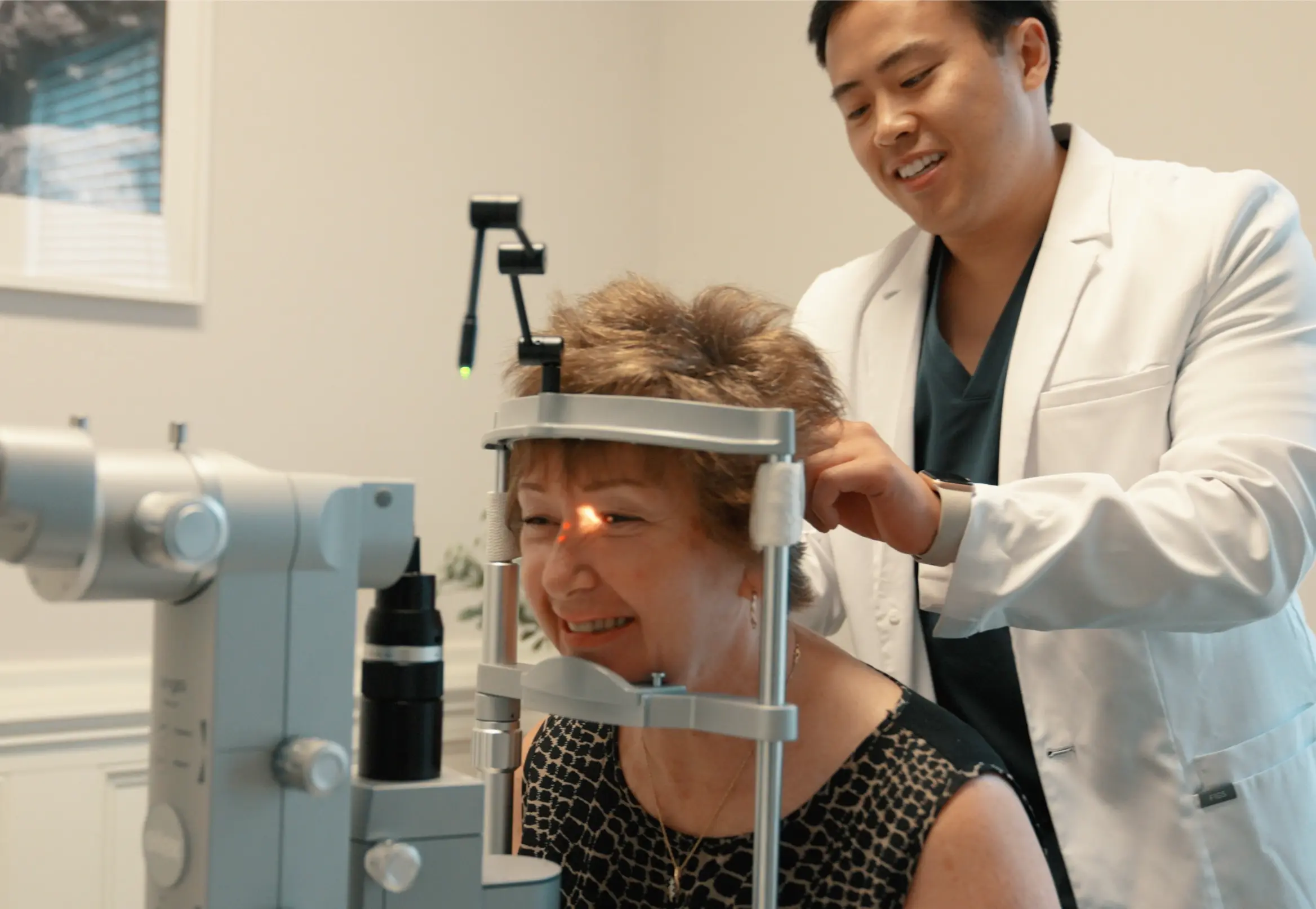
Dr. Jeffrey Tran examining a cataract patient at Stratus Eye in Suwanee, GA
Take care of the business.
The first two don't survive without it
This is the one physicians struggle to say out loud. But a practice under financial pressure eventually compromises care, cuts staff, or closes its doors — even with the best intentions. Profit is not the goal. Profit is what keeps the first two rules possible.
THE HARD TRUTH

You're Not Running a Business.
You're Running Yourself Into the Ground.

There's a version of practice ownership that looks like success from the outside. Full schedule. Growing revenue. A team that mostly functions. Patients who like you. By every visible measure, things are working.

And yet you're exhausted. You're the first one in and the last one out. Problems find you regardless of where you are or what time it is. Decisions don't get made unless you make them. The moment you step away — even for a few days — something slips.

That's not a thriving business. That's a performance. And you're the only performer. Here's the distinction that changes everything:

An operator clinically executes, personally holds everything together, and fixes problems through proximity and personality. They're good at what they do — and the practice works because they're always there. Remove them from the building and the wheels come off.

A CEO builds systems that run without them. Reviews metrics on a cadence. Plans the next quarter instead of just surviving the current one. Leads people through structure instead of presence. The practice works because the infrastructure works — not because one person is holding it together through sheer will.

The charismatic solo physician who runs a tight ship through personality alone isn't leading. They're performing. And performances don't scale. It works with eight employees. It works at one location. Add a second provider, grow the team to twenty, open a second site — and the whole thing collapses. Not because you got worse. Because that style of leadership was never pressure-tested. It only survived because you were always in the room.

Here's the question that tells you everything: Could your practice run for one week without you in the building?

Not the clinical work — that's you, and it should be. But the operations. The team. The decisions. The flow. Would it hold?If the answer is no — you don't have a practice. You have a job that looks like a business. And no amount of working harder will change that, because the bottleneck isn't your effort. It's the absence of a system that works without you. That's what the CEO framework is built to fix.

What a Practice CEO Actually Does

01
Reviews metrics
The CEO knows the numbers that drive the business — and reviews them on a cadence. Not when something feels wrong. On schedule. Which metrics? That's the entire question. Knowing that metrics matter isn't the same as knowing which ones to pull and what they're telling you.
02
Protects time to lead.
CEO Time is blocked on the calendar. Non-negotiable. Not admin squeezed between patients. Real, closed-door time dedicated to working on the business, not in it. If you have zero hours per week doing this, you are not leading. You are reacting.
03
Identifies and removes friction, not just work harder
Every practice has friction. Workflows with unnecessary steps. Handoffs that drop things. Processes nobody standardized. The CEO's job is to find the friction and fix it — not to personally compensate for it every day with extra effort.
04
Focuses on the 20% that actually moves the needle
Eighty percent of daily problems are noise. The CEO is disciplined enough to ignore most of it — and obsessed with the small number of levers that actually change outcomes: scheduling architecture, case acceptance, capacity, collections, and people performance.
05
Builds systems that run without them in the room.
The test is simple: could your practice function for one week without you physically present? If the answer is no, you don't have a business. You have a job held together by your personal presence. The CEO builds infrastructure so the answer eventually becomes yes.
06
Makes expansion decisions with data, not emotion.
Should you add a provider? Drop an insurance plan? Open a second location? The CEO answers those questions with financial signals, capacity analysis, and clear criteria — not gut feel and wishful thinking.
This is the job. The clinical work is separate. Both matter. But only one of them builds something that lasts.
Arrow
Let's Connect
What's Actually Missing

Good Doctors. Struggling Practices. Here's Why.

Blurry to clear vision comparison — cataract surgery results at Stratus Eye in Suwanee, GABlurry to clear vision comparison — cataract surgery results at Stratus Eye in Suwanee, GA
A Real Vision.
Are you building a lifestyle practice or an expansion practice? A single-location operation you own completely, or a multi-site enterprise with associate physicians? A high-margin boutique or a high-volume system? These aren't rhetorical questions. They have completely different answers for your hiring, your financials, your schedule, and your life. Without a clear vision, you default to whoever is pulling on you hardest that day — and wonder why nothing feels like progress.
Femtosecond laser cataract surgery equipment used for patients of Stratus Eye at Northside Hospital Haw Creek
Consistent Performance.
Is your overhead running at 55% or 70%? Do you know your collection rate, your no-show rate, your conversion rate from consult to procedure? Consistent performance means you can answer those questions on any given Tuesday — not just when something feels wrong. The roller coaster practice (great month, scary month, full schedule, then gaps) isn't just stressful. It's unexpandable. You cannot build, hire, or expand on top of something unpredictable.
Dr. Jeffrey Tran examining a cataract patient at Stratus Eye in Suwanee, GA
An Actual Life.
This is the one that lands hardest. If you built this practice by robbing your health, your relationships, and your sleep — you didn't get successful. You got trapped with a good income. Work life balance is why I chose to start my practice, and my family and fitnes are my focus for now. Ironman 70.3 in 2026 and Ironman 140.6 for 2027.

Identifying the gap is the easy part.
Closing it requires three things.

Knowledge
Knowing what levers to pull, when to pull them, and what the signals are telling you. Not just clinical knowledge. Business knowledge.
Discipline
Actually doing it when the day gets chaotic, the schedule is full, and everyone is pulling on you at once. Most people know what they should do. Few do it consistently.
Accountability
The multiplier most people skip entirely. Take someone with average knowledge and average discipline, hold them accountable consistently, and they become great. That's true for you. It's true for every person on your team.

The Three Pillars of a Physician-Led Practice

Not sequential. Not optional. A healthy practice runs all three — at the same time.
From eye drops to in-office laser to minimally invasive surgery
PILLAR 1

Operations — Know Where Your Practice Leaks

Every practice runs on a pipeline. A patient doesn't appear on your schedule by accident — there's a sequence of steps that either converts them or loses them long before they sit in your exam room. Do you know your new patient conversion rate? Your show rate? Where your schedule hemorrhages revenue without anyone noticing?

The CEO's job is to know exactly where that pipeline breaks down and fix the system — not personally compensate for it every day with extra effort.

You'll need to master the specific pipeline metrics, the benchmarks to measure against, and the audit process that shows you exactly where the money is going.You'll need to master

Pillar 2

Financials — Make Decisions with Signals, Not Stress

What's your overhead percentage? Your collections ratio? Your revenue per clinical hour? Your break-even point if you add an associate? If those numbers aren't immediately accessible — and interpretable — you are making six-figure decisions on instinct.

Your P&L is telling you something every single month. Dropping a payer. Adding a provider. Opening a second location. These aren't gut-feel questions. They're answerable — if you know which numbers to pull and what they're telling you.

You'll need master the fundamentals. There are three to five financial figures that change every major decision you make, and the physician-specific benchmarks to measure against.
Pillar 3

People — Build a Team That Doesn't Need You for Everything

What's your staff turnover rate? Do you have a structured onboarding process? A meeting cadence that keeps the team aligned without consuming your week? A performance review system that happens on schedule — not only when something breaks?

Your team performs at the level your leadership infrastructure supports. Not the level you want. Not the level they're capable of. The level the system actually holds them to. If that system doesn't exist, the gap between what you expect and what happens will never close.

The real game changer is making it work with B+ team members. A+ members go above and beyond. A solid system works with average players

You'll need to master the meeting cadence, the accountability framework, and the performance conversation structure that makes follow-through inevitable.
MASTER CEO TIME
If You Have No Time to Lead,
You're Not Leading.

CEO time is a non-negotiable.
Focus and be present.

How many hours per week do you spend actually leading your practice? Not seeing patients. Not charting. Not answering staff questions in the hallway. Actually leading — reviewing numbers, planning the next quarter, thinking strategically about where this thing is going.

For most solo practitioners, the honest answer is close to zero.

You're in the exam room until 6pm. You're charting at home. You're answering emails between patients. And somewhere in the back of your mind there's a list of things you keep meaning to get to — the payer contract you should renegotiate, the workflow that's been broken for months, the hire you've been putting off — that never gets touched because there is no time.

That's not a leadership problem. That's a calendar problem.

CEO Time is the fix. One blocked, protected, non-negotiable window per week dedicated entirely to working on the business — not in it. Closed door. No patients. No quick questions. No charting catch-up. Real, uninterrupted time to lead the organization you built.
Not another day off. Not admin time squeezed between appointments. A sacred block that treats the business like it deserves to be treated.

Ask yourself this: When was the last time you spent two uninterrupted hours thinking about the direction of your practice — not your schedule, not your inbox, not the problem someone dropped on your desk today?

If you can't remember, that's the answer.
SERVING NORTH ATLANTA

Glaucoma care for patients across North Atlanta

Stratus Eye is proud to serve glaucoma patients from across the North Atlanta region. Whether you're coming from Suwanee, Johns Creek, Duluth, Alpharetta, Cumming, Buford, Sugar Hill, Gainesville, or Lawrenceville, Dr. Tran provides comprehensive glaucoma evaluation and treatment — from diagnosis and eye drops to in-office SLT laser and minimally invasive surgery. Most patients tell us the peace of mind from a thorough glaucoma evaluation was worth the drive.

You know the framework.
Now, master the system.
Schedule a glaucoma evaluation at Stratus Eye in Suwanee, GA — Dr. Jeffrey Tran
The concepts on this page are the foundation. What comes next is the part that actually moves the needle — the specific tools, numbers, and processes that turn the philosophy into a practice that runs differently.

→ The exact metrics that tell you where your practice is leaking revenue and how to fix it before it becomes a crisis
→ The financial benchmarks every physician practice owner should know and what it means when yours don't match
→ The operations audit, a structured process for finding friction before it costs you
→ The CEO Time system, how to block it, protect it from a team that will try to fill it, and what to do during it
→ The expansion readiness checklist, the specific signals that tell you when to grow and when growth will break you
→ The accountability framework that makes follow-through the default for you and your entire team